Little Paddocks
A Murder Is AnnouncedLittle Paddocks is Miss Blacklock’s house in Chipping Cleghorn, the setting named in the newspaper announcement that a murder would take place on Friday, October 29, at 6:30 p.m. The gathering held there appears at first to be a party game, but a real shooting makes the house both the scene of the crime and the physical mechanism by which its perpetrator escapes notice. Its domestic arrangements—the drawing-room, its doors, a lamp and a vase of violets—are not incidental background: they are central to the staged attack and its eventual reconstruction.
House and Household
At breakfast, Miss Blacklock sits at the head of the table as owner of the house. Julia Simmons reads the Telegraph, Patrick Simmons works on a crossword, and Dora Bunner gives her attention to the local weekly paper. This everyday household scene contrasts with the extraordinary notice circulating in the village: the advertised crime is to happen at the very home where ordinary routines continue.
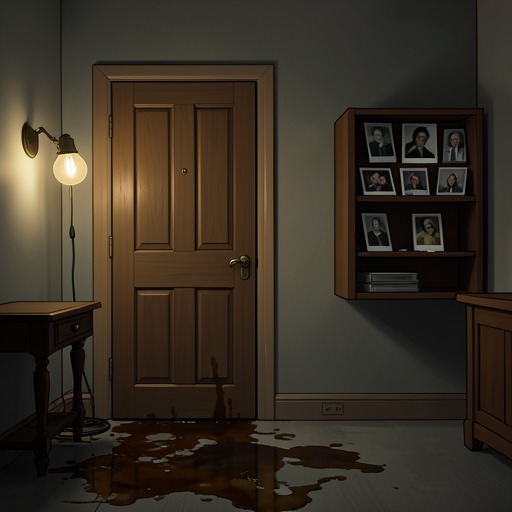
The house is described as medium-sized and early Victorian, with a long, shallow veranda and green-shuttered windows. Its long, narrow drawing-room loses some of its light beneath the veranda roof. At one end, double doors had once connected it to a small room with a bay window; a previous generation removed the doors and replaced them with velvet portieres. Miss Blacklock later dispensed with the portieres, leaving the two rooms open as one. There is a fireplace at either end, but neither is lit when the guests assemble, although the room is warm from central heating.
The Announced Gathering and Shooting
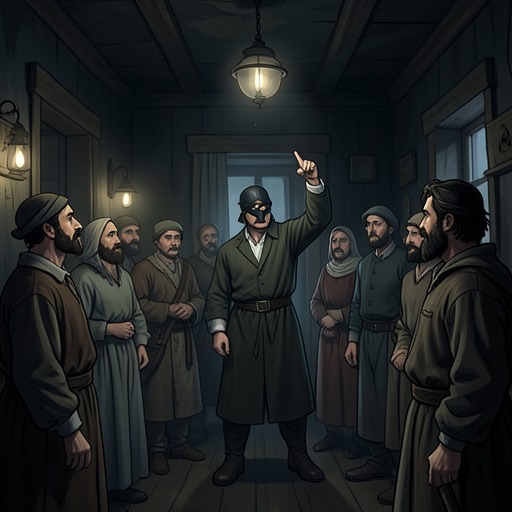
The murder notice gives the house a precise public identity before the crime occurs: Little Paddocks is named as the location and 6:30 p.m. as the appointed time. The invitation encourages the expectation of a party game in which a chosen player acts as murderer, the lights go out, and someone plays the victim. That distinction collapses when a real gun is fired during the gathering.
As the guests assemble in the drawing-room, its furnishings include rose-patterned chintzes, two bowls of bronze chrysanthemums, a small vase of violets, and a silver cigarette-box on a table by the wall. A revolver fires twice; the figure in the doorway turns, a third shot sounds, and the figure falls. The flashlight drops and goes out. In the ensuing darkness, the drawing-room door swings shut and latches. The ordinary movement of a door thus becomes part of the scene’s confusion, while the house’s layout helps make the apparent attack seem to have unfolded in front of everyone.
The House as a Mechanism of Deception
The later investigation identifies the drawing-room’s altered doorway as a practical advantage for the person who arranged the shooting. Sergeant Fletcher examines the house while Miss Blacklock and Dora Bunner are away in the village. He concludes that someone had oiled and prepared the door to leave the drawing-room unnoticed once the lights went out; that clue rules out Mitzi, who would not have needed to use it.
In the final reconstruction, Jane Marple explains how the room’s furnishings and lighting were made to serve the plan. Miss Blacklock had arranged for no fire to be lit, so a fire would not reveal people in the dark. She had also frayed the lamp cord until its wires were nearly bare. At the appointed moment, while the guests’ attention turned toward the chiming clock, she picked up the vase of violets, spilled its water onto the damaged cord, and switched on the lamp. The water caused the wires to fuse, plunging the room into darkness. The vase, lamp, cigarette-box, and switch were close together: a familiar domestic arrangement concealed the trigger for the blackout.
Miss Blacklock had also altered the space to make the preparations appear natural. She suggested moving the table outside the door so that Phillipa Haymes’s flower arrangements would show to better advantage. Later, she used the oiled door to leave the room unseen. These details transform the apparently open, shared drawing-room into a space with a concealed route and a carefully prepared sequence of actions.
Crime Scene and Narrative Significance
The reconstruction places the crime within the house’s ordinary schedule. Miss Blacklock went out shortly after six to shut up the ducks, let Rudi Scherz in, and gave him the mask, cloak, gloves, and flashlight for his part in the staged hold-up. At 6:30 she stood near the table with her hand on the cigarette-box, appearing to fetch cigarettes while Patrick acted as host and went for drinks. When the clock chimed, the guests looked toward it; Dora alone kept her attention on her friend and noticed her pick up the violets.
Once the room was dark, Miss Blacklock passed through the prepared doorway and approached Rudi from behind while he played the intruder. She fired at him, left the revolver by his body, and returned through the other door to her previous place. She then used a staged injury to support the impression that she, too, had been attacked. Mitzi, watching from the dining-room, saw Miss Blacklock with a revolver behind Rudi; that observation eventually helped expose what had happened, although the keyhole made the supposed sighting appear questionable.
Little Paddocks is therefore more than a named setting for the murder: its rooms, doors, central heating, and small objects form the practical architecture of the deception. The same house that lets the gathering pass as a game supplies the clues by which the game is reclassified as a real killing. The advertised location, initially presented as a place for an entertaining mystery, becomes the evidence-bearing space in which Miss Blacklock’s arrangements can finally be understood.